Thursday, February 2, 2012
IPhone 5 update
It’s not the most shocking suggestion that has surfaced about the iPhone 5, but there is new substantive info linking the latest and greatest Apple handset to the company’s Worldwide Developers Conference in June. In addition, new speculation has surfaced about what might make the new device worthy of a numerical upgrade that the iPhone 4S couldn’t achieve. One such nugget is that the touch panel will have what’s called “glass-to-glass” technology.

IPhone 5 new Applications 101
Development of the iPhone began in 2005 with Apple CEO Steve Jobs' direction that Apple engineers investigate touchscreens.[6] He also steered the original focus away from a tablet, like the iPad, and towards a phone.[7] Apple created the device during a secretive collaboration with AT&T Mobility—Cingular Wireless at the time—at an estimated development cost of US$150 million over thirty months.[8]
Apple rejected the "design by committee" approach that had yielded the Motorola ROKR E1, a largely unsuccessful[9] collaboration with Motorola. Instead, Cingular gave Apple the liberty to develop the iPhone's hardware and software in-house[10][11] and even paid Apple a fraction of its monthly service revenue (until the iPhone 3G),[12] in exchange for four years of exclusive U.S. sales, until 2011.
Jobs unveiled the iPhone to the public on January 9, 2007 at the Macworld 2007 convention at the Moscone Center in San Francisco. The iPhone went on sale in the United States on June 29, 2007, at 6:00 pm local time, while hundreds of customers lined up outside the stores nationwide.[13] The passionate reaction to the launch of the iPhone resulted in sections of the media christening it the 'Jesus phone'.[14][15] The original iPhone was made available in the UK, France, and Germany in November 2007, and Ireland and Austria in the spring of 2008.

 Worldwide iPhone availability:On July 11, 2008, Apple released the iPhone 3G in twenty-two countries, including the original six.[16] Apple released the iPhone 3G in upwards of eighty countries and territories.[17] Apple announced the iPhone 3GS on June 8, 2009, along with plans to release it later in June, July, and August, starting with the U.S., Canada and major European countries on June 19. Many would-be users objected to the iPhone's cost,[18] and 40% of users have household incomes over US$100,000.[19]
In an attempt to gain a wider market, Apple retained the 8 GB iPhone 3G at a lower price point. When Apple introduced the iPhone 4, the 3GS became the less expensive model. Apple reduced the price several times since the iPhone's release in 2007, at which time an 8 GB iPhone sold for $599. An iPhone 3GS with the same capacity now has no cost to the customer, as of the release of the iPhone 4S. However, these numbers are misleading, since all iPhone units sold through AT&T require a two-year contract (costing several thousand dollars and including an early termination fee[20]), and a SIM lock.
Apple sold 6.1 million original iPhone units over five quarters.[21] Recorded sales have been growing steadily thereafter, and by the end of fiscal year 2010, a total of 73.5 million iPhones were sold.[22] By 2010/2011, the iPhone has a market share of barely 4% of all cellphones, but Apple still pulls in more than 50% of the total profit that global cellphone sales generate.[23] Sales in Q4 2008 surpassed temporarily those of RIM's BlackBerry sales of 5.2 million units, which made Apple briefly the third largest mobile phone manufacturer by revenue, after Nokia and Samsung.[24] Approximately 6.4 million iPhones are active in the U.S. alone.[19] While iPhone sales constitute a significant portion of Apple's revenue, some of this income is deferred.[25]
 Three generations of iPhone, shown from behind. Left to right: original, white 3G, black 4.The back of the original iPhone was made of aluminum with a black plastic accent. The iPhone 3G and 3GS feature a full plastic back to increase the strength of the GSM signal.[26] The iPhone 3G was available in an 8 GB black model, or a black or white option for the 16 GB model. They both are now discontinued. The iPhone 3GS was available in both colors, regardless of storage capacity.
The white model was discontinued in favor of a black 8 GB low-end model. The iPhone 4 has an aluminosilicate glass front and back with a stainless steel edge that serves as the antennas. It was at first available in black; the white version was announced, but not released until April 2011, 10 months later.
The iPhone has garnered positive reviews from such critics as David Pogue[27] and Walter Mossberg.[28][29] The iPhone attracts users of all ages,[19] and, besides consumer use, the iPhone has also been adopted for business purposes.[30]
Users of the iPhone 4 reported dropped/disconnected telephone calls when holding their phones in a certain way. This became known as antennagate. [31]
On January 11, 2011, Verizon announced during a media event that it had reached an agreement with Apple and would begin selling a CDMA2000 iPhone 4. Verizon said it would be available for pre-order on February 3, with a release set for February 10.[32][33] In February 2011, the Verizon iPhone accounted for 4.5 percent of all iPhone ad impressions[vague] in the U.S. on Millennial Media's mobile ad network.[34] On March 2, 2011, at the iPad 2 event, Apple announced that they have sold 100 million iPhones worldwide and the phone has been consistently recognised as one of the best phones on earth.[who?].[35][36]
On Tuesday, September 27, Apple sent invitations for a press event to be held October 4, 2011 at 10:00AM at the Cupertino Headquarters to announce details of the next generation iPhone, which turned out to be iPhone 4S. Over 1 million 4S models were sold in the first 24 hours after its release in October 2011.[37] Due to large volumes of the iPhone being manufactured and the its high selling price, Apple became the largest mobile handset vendor in the world by revenue, in 2011, surpassing long-time leader Nokia;[38] however, later that year, it was surpassed by Samsung, a major manufacturer of Android phones.[39] American carrier C Spire Wireless announced that it would be carrying the iPhone 4S on October 19, 2011.[5] In December 2011, ComScore reported that 10.8% of mobile subscribers use an iPhone.[40]
The touch and gesture features of the iPhone are based on technology originally developed by FingerWorks.[42] Most gloves and styluses prevent the necessary electrical conductivity;[43][44][45][46] however, capacitive styli can be used with iPhone's finger-touch screen. The iPhone 3GS and later also feature a fingerprint-resistant oleophobic coating.[47]
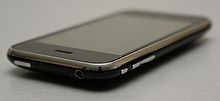 The top and side of an iPhone 3GS, externally identical to the iPhone 3G. From left to right, sides: wake/sleep button, SIM card slot, headphone jack, silence switch, volume controls. The switches were black plastic on the original iPhone. Top: earpiece, screen.The iPhone has a minimal hardware user interface, featuring only four or five buttons, depending on the generation. The only physical menu button is situated directly below the display, and is called the "Home button" because it closes the active app and navigates to the home screen of the interface. The home button is denoted not by a house, as on many other similar devices, but a rounded square, reminiscent of the shape of icons on the home screen.
A multifunction sleep/wake button is located on the top of the device. It serves as the unit's power button, and also controls phone calls. When a call is received, pressing the sleep/wake button once silences the ringtone, and when pressed twice transfers the call to voicemail. Situated on the left spine are the volume adjustment controls. The iPhone 4 has two separate circular buttons to increase and decrease the volume; all earlier models house two switches under a single plastic panel, known as a rocker switch, which could reasonably be counted as either one or two buttons.
Directly above the volume controls is a ring/silent switch that when engaged mutes telephone ringing, alert sounds from new & sent emails, text messages, and other push notifications, camera shutter sounds, Voice Memo sound effects, phone lock/unlock sounds, keyboard clicks, and spoken autocorrections. This switch does not mute alarm sounds from the Clock application, and in some countries or regions it will not mute the camera shutter or Voice Memo sound effects.[48] All buttons except Home were made of plastic on the original iPhone and metal on all later models. The touchscreen furnishes the remainder of the user interface.
The display responds to three sensors (four on the iPhone 4). A proximity sensor deactivates the display and touchscreen when the device is brought near the face during a call. This is done to save battery power and to prevent inadvertent inputs from the user's face and ears. An ambient light sensor adjusts the display brightness which in turn saves battery power. A 3-axis accelerometer senses the orientation of the phone and changes the screen accordingly, allowing the user to easily switch between portrait and landscape mode.[49] Photo browsing, web browsing, and music playing support both upright and left or right widescreen orientations.[50]
Unlike the iPad, the iPhone does not rotate the screen when turned upside-down, with the Home button above the screen, unless the running program has been specifically designed to do so. The 3.0 update added landscape support for still other applications, such as email, and introduced shaking the unit as a form of input.[51][52] The accelerometer can also be used to control third-party apps, notably games. The iPhone 4 also includes a gyroscopic sensor, enhancing its perception of how it is moved.
A software update in January 2008[53] allowed the first-generation iPhone to use cell tower and Wi-Fi network locations trilateration,[54] despite lacking GPS hardware. The iPhone 3G, 3GS and 4 employ A-GPS, and the iPhone 3GS and 4 also have a digital compass.[55] iPhone 4S supports GLONASS global positioning system in addition to GPS.
 One of two speakers (left) and the microphone (right) surround the dock connector on the base of the original iPhone. If a headset is plugged in, sound is played through it instead.The bottom of the iPhone sports a speaker (left) and a microphone (right) flanking the dock connector. One loudspeaker is located above the screen as an earpiece, and another is located on the left side of the bottom of the unit, opposite a microphone on the bottom-right. The iPhone 4 includes an additional microphone at the top of the unit for noise cancellation, and switches the placement of the microphone and speaker on the base on the unit—the speaker is on the right.[56] Volume controls are located on the left side of all iPhone models and as a slider in the iPod application.
The 3.5 mm TRRS connector for the headphones is located on the top left corner of the device.[57] The headphone socket on the original iPhone is recessed into the casing, making it incompatible with most headsets without the use of an adapter.[58][59] Subsequent generations eliminated the issue by using a flush-mounted headphone socket. Cars equipped with an auxiliary jack allow for handsfree use of the iPhone while driving as a substitute for Bluetooth.
While the iPhone is compatible with normal headphones, Apple provides a headset with additional functionality. A multipurpose button near the microphone can be used to play or pause music, skip tracks, and answer or end phone calls without touching the iPhone. A small number of third-party headsets specifically designed for the iPhone also include the microphone and control button.[60] The current headsets also provide volume controls, which are only compatible with more recent models.[61] These features are achieved by a fourth ring in the audio jack that carries this extra information.
The built-in Bluetooth 2.x+EDR supports wireless earpieces and headphones, which requires the HSP profile. Stereo audio was added in the 3.0 update for hardware that supports A2DP.[51][52] While non-sanctioned third-party solutions exist, the iPhone does not officially support the OBEX file transfer protocol.[62] The lack of these profiles prevents iPhone users from exchanging multimedia files, such as pictures, music and videos, with other bluetooth-enabled cell phones.
Composite[63] or component[64] video at up to 576i and stereo audio can be output from the dock connector using an adapter sold by Apple. iPhone 4 also supports 1024x768 VGA output[65] without audio, and HDMI output,[66] with stereo audio, via dock adapters. The iPhone did not support voice recording until the 3.0 software update.[51][52]
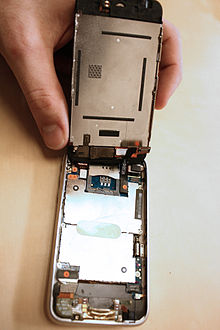 Replacing the battery requires opening the iPhone unit and exposing the internal hardwareThe iPhone features an internal rechargeable lithium-ion battery. Like an iPod, but unlike most other mobile phones, the battery is not user-replaceable.[58][67] The iPhone can be charged when connected to a computer for syncing across the included USB to dock connector cable, similar to charging an iPod. Alternatively, a USB to AC adapter (or "wall charger," also included) can be connected to the cable to charge directly from an AC outlet. A number of third-party accessories (car chargers, portable chargers, battery cases, stereo dock chargers, and even solar chargers) are also available.[citation needed]
Apple runs tests on preproduction units to determine battery life. Apple's website says that the battery life "is designed to retain up to 80 percent of its original capacity after 400 full charge and discharge cycles",[68] which is comparable to iPod batteries.
The battery life of early models of the iPhone has been criticized by several technology journalists as insufficient and less than Apple's claims.[69][70][71][72] This is also reflected by a J. D. Power and Associates customer satisfaction survey, which gave the "battery aspects" of the iPhone 3G its lowest rating of 2 out of 5 stars.[73][74]
If the battery malfunctions or dies prematurely, the phone can be returned to Apple and replaced for free while still under warranty.[75] The warranty lasts one year from purchase and can be extended to two years with AppleCare. The battery replacement service and its pricing was not made known to buyers until the day the product was launched,[76][77] it is similar to how Apple (and third parties) replace batteries for iPods. The Foundation for Taxpayer and Consumer Rights, a consumer advocate group, has sent a complaint to Apple and AT&T over the fee that consumers have to pay to have the battery replaced.[76]
Since July 2007, third-party battery replacement kits have been available[78] at a much lower price than Apple's own battery replacement program. These kits often include a small screwdriver and an instruction leaflet, but as with many newer iPod models the battery in the original iPhone has been soldered in. Therefore a soldering iron is required to install the new battery. The iPhone 3G uses a different battery fitted with a connector that is easier to replace.[79]
The iPhone 3GS has a 3.2 megapixel camera, manufactured by OmniVision, featuring autofocus, auto white balance, and auto macro (up to 10 cm). It is also capable of capturing 640x480 (VGA resolution) video at 30 frames per second,[80] although compared to higher-end CCD based video cameras it does exhibit the rolling shutter effect.[81] The video can then be cropped on the device itself and directly uploaded to YouTube, MobileMe, or other services.
The iPhone 4 introduced a 5.0 megapixel camera (2592x1936 pixels), also located on the back, which is equipped with a backside illuminated sensor capable of capturing pictures in low-light conditions, as well as an LED flash capable of staying lit for video recording at 720p resolution, considered high-definition.[82] iPhone 4 is the first iPhone that has the high dynamic range photography feature.[83] In addition the iPhone 4 has a second camera on the front capable of VGA photos and SD video recording.
Regardless of the source, saved recordings may be synced to the host computer, attached to email, or (where supported) sent by MMS. Videos may be uploaded to YouTube directly.
The camera on the iPhone 4S is capable of shooting 8MP stills and recording 1080p videos. The camera can now be accessed directly from the lock screen, and the volume up button as a shutter trigger. The built-in gyroscope is able to stabilize the camera while recording video.
Beta code pulled from iOS 5 suggests that the next feature to be released will allow users to capture a panoramic photo on their iPhone.[84]
On all five model generations, the phone can be configured to bring up the camera app by quickly pressing the home key twice.[85] On all iPhones running iOS 5 it can also be accessed from the lock screen directly.
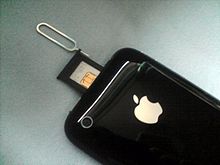 An iPhone 3G with the SIM slot open. The SIM ejector tool is still placed in the eject hole.The iPhone was initially released with two options for internal storage size: 4 GB or 8 GB. On September 5, 2007, Apple discontinued the 4 GB models.[86] On February 5, 2008, Apple added a 16 GB model.[87] The iPhone 3G was available in 16 GB and 8 GB. The iPhone 3GS came in 16 GB and 32 GB variants and still is available in 8 GB.
The iPhone 4 is available in 16 GB and 32 GB variants, as well as a newly introduced 8 GB variant to be sold along side the iPhone 4S at a reduced price point. The iPhone 4S is available in three sizes: 16 GB, 32 GB and 64 GB. All data is stored on the internal flash drive; the iPhone does not support expanded storage through a memory card slot, or the SIM card.
GSM Models of the iPhone use a SIM card to identify themselves to the GSM network. The SIM sits in a tray, which is inserted into a slot at the top of the device. The SIM tray can be ejected with a paperclip or the "SIM ejector tool" (a simple piece of die-cut sheet metal) included with the iPhone 3G and 3GS.[88][89] Some iPhone models shipped with a SIM ejector tool which was fabricated from an alloy dubbed "Liquidmetal".[90] In most countries, the iPhone is usually sold with a SIM lock, which prevents the iPhone from being used on a different mobile network.[91]
The GSM iPhone 4 features a MicroSIM card that is located in a slot on the right side of the device.[92]
The CDMA model of the iPhone, like all CDMA phones, does not use a SIM.
great phone cool apps @ losersquad.com
Apple rejected the "design by committee" approach that had yielded the Motorola ROKR E1, a largely unsuccessful[9] collaboration with Motorola. Instead, Cingular gave Apple the liberty to develop the iPhone's hardware and software in-house[10][11] and even paid Apple a fraction of its monthly service revenue (until the iPhone 3G),[12] in exchange for four years of exclusive U.S. sales, until 2011.
Jobs unveiled the iPhone to the public on January 9, 2007 at the Macworld 2007 convention at the Moscone Center in San Francisco. The iPhone went on sale in the United States on June 29, 2007, at 6:00 pm local time, while hundreds of customers lined up outside the stores nationwide.[13] The passionate reaction to the launch of the iPhone resulted in sections of the media christening it the 'Jesus phone'.[14][15] The original iPhone was made available in the UK, France, and Germany in November 2007, and Ireland and Austria in the spring of 2008.

iPhone was available since its original release
iPhone was available since the release of iPhone 3G
Coming soon
In an attempt to gain a wider market, Apple retained the 8 GB iPhone 3G at a lower price point. When Apple introduced the iPhone 4, the 3GS became the less expensive model. Apple reduced the price several times since the iPhone's release in 2007, at which time an 8 GB iPhone sold for $599. An iPhone 3GS with the same capacity now has no cost to the customer, as of the release of the iPhone 4S. However, these numbers are misleading, since all iPhone units sold through AT&T require a two-year contract (costing several thousand dollars and including an early termination fee[20]), and a SIM lock.
Apple sold 6.1 million original iPhone units over five quarters.[21] Recorded sales have been growing steadily thereafter, and by the end of fiscal year 2010, a total of 73.5 million iPhones were sold.[22] By 2010/2011, the iPhone has a market share of barely 4% of all cellphones, but Apple still pulls in more than 50% of the total profit that global cellphone sales generate.[23] Sales in Q4 2008 surpassed temporarily those of RIM's BlackBerry sales of 5.2 million units, which made Apple briefly the third largest mobile phone manufacturer by revenue, after Nokia and Samsung.[24] Approximately 6.4 million iPhones are active in the U.S. alone.[19] While iPhone sales constitute a significant portion of Apple's revenue, some of this income is deferred.[25]

The white model was discontinued in favor of a black 8 GB low-end model. The iPhone 4 has an aluminosilicate glass front and back with a stainless steel edge that serves as the antennas. It was at first available in black; the white version was announced, but not released until April 2011, 10 months later.
The iPhone has garnered positive reviews from such critics as David Pogue[27] and Walter Mossberg.[28][29] The iPhone attracts users of all ages,[19] and, besides consumer use, the iPhone has also been adopted for business purposes.[30]
Users of the iPhone 4 reported dropped/disconnected telephone calls when holding their phones in a certain way. This became known as antennagate. [31]
On January 11, 2011, Verizon announced during a media event that it had reached an agreement with Apple and would begin selling a CDMA2000 iPhone 4. Verizon said it would be available for pre-order on February 3, with a release set for February 10.[32][33] In February 2011, the Verizon iPhone accounted for 4.5 percent of all iPhone ad impressions[vague] in the U.S. on Millennial Media's mobile ad network.[34] On March 2, 2011, at the iPad 2 event, Apple announced that they have sold 100 million iPhones worldwide and the phone has been consistently recognised as one of the best phones on earth.[who?].[35][36]
On Tuesday, September 27, Apple sent invitations for a press event to be held October 4, 2011 at 10:00AM at the Cupertino Headquarters to announce details of the next generation iPhone, which turned out to be iPhone 4S. Over 1 million 4S models were sold in the first 24 hours after its release in October 2011.[37] Due to large volumes of the iPhone being manufactured and the its high selling price, Apple became the largest mobile handset vendor in the world by revenue, in 2011, surpassing long-time leader Nokia;[38] however, later that year, it was surpassed by Samsung, a major manufacturer of Android phones.[39] American carrier C Spire Wireless announced that it would be carrying the iPhone 4S on October 19, 2011.[5] In December 2011, ComScore reported that 10.8% of mobile subscribers use an iPhone.[40]
Hardware
Screen and input
The touchscreen is a 9 cm (3.5 in) liquid crystal display with scratch-resistant glass.[41] The capacitive touchscreen is designed for a bare finger, or multiple fingers for multi-touch sensing. The screens on the first three generations have a resolution of 320 × 480 (HVGA) at 163 ppi, while that of iPhone 4 and iPhone 4S has a resolution of 640 × 960 at 326 ppi.The touch and gesture features of the iPhone are based on technology originally developed by FingerWorks.[42] Most gloves and styluses prevent the necessary electrical conductivity;[43][44][45][46] however, capacitive styli can be used with iPhone's finger-touch screen. The iPhone 3GS and later also feature a fingerprint-resistant oleophobic coating.[47]

A multifunction sleep/wake button is located on the top of the device. It serves as the unit's power button, and also controls phone calls. When a call is received, pressing the sleep/wake button once silences the ringtone, and when pressed twice transfers the call to voicemail. Situated on the left spine are the volume adjustment controls. The iPhone 4 has two separate circular buttons to increase and decrease the volume; all earlier models house two switches under a single plastic panel, known as a rocker switch, which could reasonably be counted as either one or two buttons.
Directly above the volume controls is a ring/silent switch that when engaged mutes telephone ringing, alert sounds from new & sent emails, text messages, and other push notifications, camera shutter sounds, Voice Memo sound effects, phone lock/unlock sounds, keyboard clicks, and spoken autocorrections. This switch does not mute alarm sounds from the Clock application, and in some countries or regions it will not mute the camera shutter or Voice Memo sound effects.[48] All buttons except Home were made of plastic on the original iPhone and metal on all later models. The touchscreen furnishes the remainder of the user interface.
The display responds to three sensors (four on the iPhone 4). A proximity sensor deactivates the display and touchscreen when the device is brought near the face during a call. This is done to save battery power and to prevent inadvertent inputs from the user's face and ears. An ambient light sensor adjusts the display brightness which in turn saves battery power. A 3-axis accelerometer senses the orientation of the phone and changes the screen accordingly, allowing the user to easily switch between portrait and landscape mode.[49] Photo browsing, web browsing, and music playing support both upright and left or right widescreen orientations.[50]
Unlike the iPad, the iPhone does not rotate the screen when turned upside-down, with the Home button above the screen, unless the running program has been specifically designed to do so. The 3.0 update added landscape support for still other applications, such as email, and introduced shaking the unit as a form of input.[51][52] The accelerometer can also be used to control third-party apps, notably games. The iPhone 4 also includes a gyroscopic sensor, enhancing its perception of how it is moved.
A software update in January 2008[53] allowed the first-generation iPhone to use cell tower and Wi-Fi network locations trilateration,[54] despite lacking GPS hardware. The iPhone 3G, 3GS and 4 employ A-GPS, and the iPhone 3GS and 4 also have a digital compass.[55] iPhone 4S supports GLONASS global positioning system in addition to GPS.
Audio and output

The 3.5 mm TRRS connector for the headphones is located on the top left corner of the device.[57] The headphone socket on the original iPhone is recessed into the casing, making it incompatible with most headsets without the use of an adapter.[58][59] Subsequent generations eliminated the issue by using a flush-mounted headphone socket. Cars equipped with an auxiliary jack allow for handsfree use of the iPhone while driving as a substitute for Bluetooth.
While the iPhone is compatible with normal headphones, Apple provides a headset with additional functionality. A multipurpose button near the microphone can be used to play or pause music, skip tracks, and answer or end phone calls without touching the iPhone. A small number of third-party headsets specifically designed for the iPhone also include the microphone and control button.[60] The current headsets also provide volume controls, which are only compatible with more recent models.[61] These features are achieved by a fourth ring in the audio jack that carries this extra information.
The built-in Bluetooth 2.x+EDR supports wireless earpieces and headphones, which requires the HSP profile. Stereo audio was added in the 3.0 update for hardware that supports A2DP.[51][52] While non-sanctioned third-party solutions exist, the iPhone does not officially support the OBEX file transfer protocol.[62] The lack of these profiles prevents iPhone users from exchanging multimedia files, such as pictures, music and videos, with other bluetooth-enabled cell phones.
Composite[63] or component[64] video at up to 576i and stereo audio can be output from the dock connector using an adapter sold by Apple. iPhone 4 also supports 1024x768 VGA output[65] without audio, and HDMI output,[66] with stereo audio, via dock adapters. The iPhone did not support voice recording until the 3.0 software update.[51][52]
Battery

Apple runs tests on preproduction units to determine battery life. Apple's website says that the battery life "is designed to retain up to 80 percent of its original capacity after 400 full charge and discharge cycles",[68] which is comparable to iPod batteries.
The battery life of early models of the iPhone has been criticized by several technology journalists as insufficient and less than Apple's claims.[69][70][71][72] This is also reflected by a J. D. Power and Associates customer satisfaction survey, which gave the "battery aspects" of the iPhone 3G its lowest rating of 2 out of 5 stars.[73][74]
If the battery malfunctions or dies prematurely, the phone can be returned to Apple and replaced for free while still under warranty.[75] The warranty lasts one year from purchase and can be extended to two years with AppleCare. The battery replacement service and its pricing was not made known to buyers until the day the product was launched,[76][77] it is similar to how Apple (and third parties) replace batteries for iPods. The Foundation for Taxpayer and Consumer Rights, a consumer advocate group, has sent a complaint to Apple and AT&T over the fee that consumers have to pay to have the battery replaced.[76]
Since July 2007, third-party battery replacement kits have been available[78] at a much lower price than Apple's own battery replacement program. These kits often include a small screwdriver and an instruction leaflet, but as with many newer iPod models the battery in the original iPhone has been soldered in. Therefore a soldering iron is required to install the new battery. The iPhone 3G uses a different battery fitted with a connector that is easier to replace.[79]

Camera
The original iPhone and iPhone 3G feature a built-in Fixed focus 2.0 megapixel camera located on the back for still digital photos. It has no optical zoom, flash or autofocus, and does not support video recording (iPhone 3G does support video recording via third-party App available on the App Store), however jailbreaking allows users to do so. Version 2.0 of iPhone OS introduced the capability to embed location data in the pictures, producing geocoded photographs.The iPhone 3GS has a 3.2 megapixel camera, manufactured by OmniVision, featuring autofocus, auto white balance, and auto macro (up to 10 cm). It is also capable of capturing 640x480 (VGA resolution) video at 30 frames per second,[80] although compared to higher-end CCD based video cameras it does exhibit the rolling shutter effect.[81] The video can then be cropped on the device itself and directly uploaded to YouTube, MobileMe, or other services.
The iPhone 4 introduced a 5.0 megapixel camera (2592x1936 pixels), also located on the back, which is equipped with a backside illuminated sensor capable of capturing pictures in low-light conditions, as well as an LED flash capable of staying lit for video recording at 720p resolution, considered high-definition.[82] iPhone 4 is the first iPhone that has the high dynamic range photography feature.[83] In addition the iPhone 4 has a second camera on the front capable of VGA photos and SD video recording.
Regardless of the source, saved recordings may be synced to the host computer, attached to email, or (where supported) sent by MMS. Videos may be uploaded to YouTube directly.
The camera on the iPhone 4S is capable of shooting 8MP stills and recording 1080p videos. The camera can now be accessed directly from the lock screen, and the volume up button as a shutter trigger. The built-in gyroscope is able to stabilize the camera while recording video.
Beta code pulled from iOS 5 suggests that the next feature to be released will allow users to capture a panoramic photo on their iPhone.[84]
On all five model generations, the phone can be configured to bring up the camera app by quickly pressing the home key twice.[85] On all iPhones running iOS 5 it can also be accessed from the lock screen directly.
Storage and SIM

The iPhone 4 is available in 16 GB and 32 GB variants, as well as a newly introduced 8 GB variant to be sold along side the iPhone 4S at a reduced price point. The iPhone 4S is available in three sizes: 16 GB, 32 GB and 64 GB. All data is stored on the internal flash drive; the iPhone does not support expanded storage through a memory card slot, or the SIM card.
GSM Models of the iPhone use a SIM card to identify themselves to the GSM network. The SIM sits in a tray, which is inserted into a slot at the top of the device. The SIM tray can be ejected with a paperclip or the "SIM ejector tool" (a simple piece of die-cut sheet metal) included with the iPhone 3G and 3GS.[88][89] Some iPhone models shipped with a SIM ejector tool which was fabricated from an alloy dubbed "Liquidmetal".[90] In most countries, the iPhone is usually sold with a SIM lock, which prevents the iPhone from being used on a different mobile network.[91]
The GSM iPhone 4 features a MicroSIM card that is located in a slot on the right side of the device.[92]
The CDMA model of the iPhone, like all CDMA phones, does not use a SIM.
great phone cool apps @ losersquad.com
Subscribe to:
Posts (Atom)